
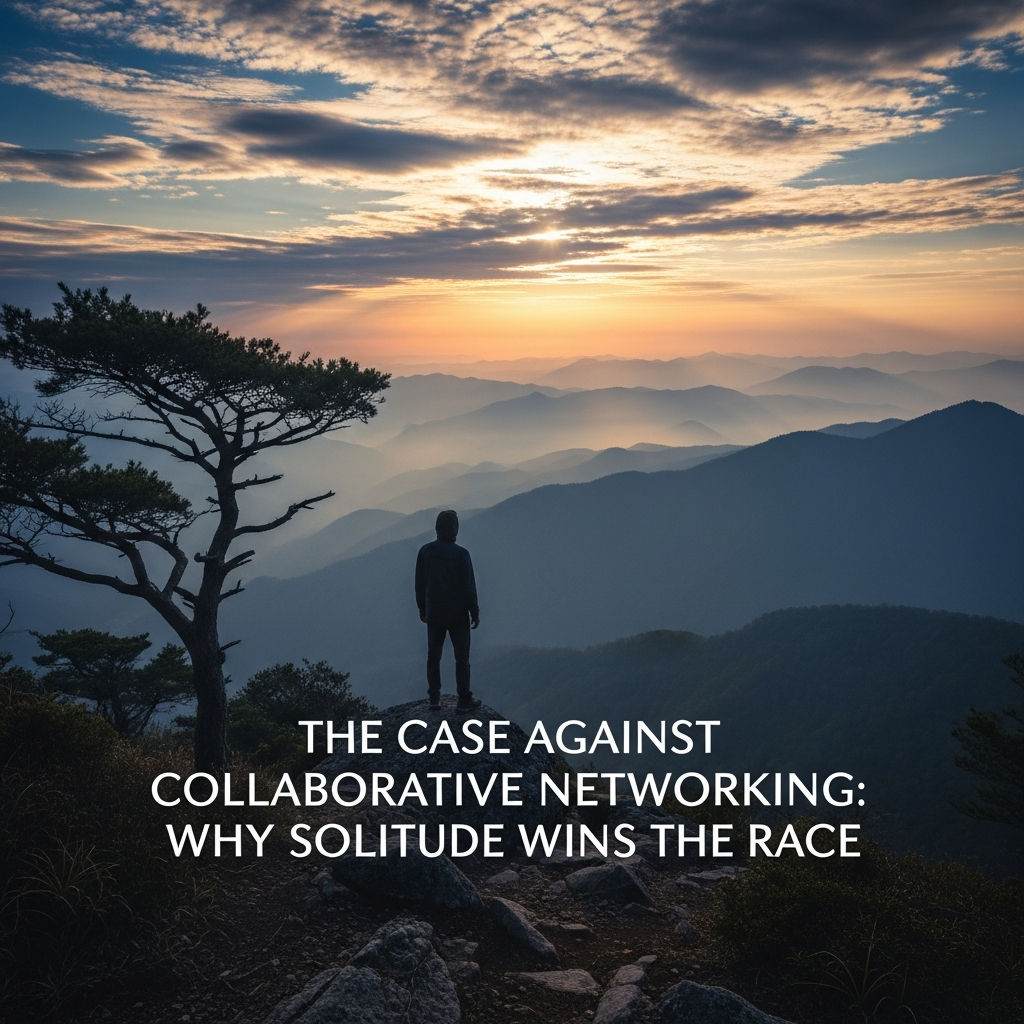
The Case Against Collaborative Networking: Why Solitude Wins the Race


“`html
The Case Against Collaborative Networking: Why Solitude Wins the Race
For the past two decades, the professional world has been obsessed with a single mantra: “Your network is your net worth.” From LinkedIn influencers to corporate team-building retreats, the message is clear—if you aren’t constantly connecting, collaborating, and “synergizing,” you’re falling behind. We are told that innovation is a team sport and that the “lone genius” is a myth of the past.
However, as burnout rates skyrocket and original thought becomes increasingly rare in a sea of homogenized content, a counter-narrative is emerging. The relentless pursuit of collaborative networking may actually be the very thing holding you back. While the world screams for more connectivity, the high achievers, the deep thinkers, and the true disruptors are rediscovering a potent, forgotten competitive advantage: solitude.
The Dilution of Originality: The Groupthink Trap
The primary argument for collaborative networking is that “two heads are better than one.” While this might be true for moving heavy furniture, it is rarely true for high-level creative or strategic breakthroughs. When we constantly network and collaborate, we expose our nascent ideas to the “committee effect” before they are fully formed.
Collaborative environments often prioritize consensus over correctness. To maintain social harmony within a network, individuals frequently subconsciously self-censor, filtering out their most radical (and potentially most valuable) ideas to avoid friction. This leads to “Groupthink”—a psychological phenomenon where the desire for conformity results in irrational or dysfunctional decision-making. In solitude, there is no one to please, no status to protect, and no need to compromise. Solitude allows an idea to grow to its full, unfiltered potential.
The High Cost of Context Switching
Modern networking isn’t just about the occasional cocktail hour; it’s an always-on digital obligation. Between Slack channels, LinkedIn messages, “quick sync” Zoom calls, and coffee chats, the modern professional is in a state of perpetual interruption. This is the antithesis of what Cal Newport calls “Deep Work.”
Deep work is the ability to focus without distraction on a cognitively demanding task. It is a superpower in our increasingly competitive 21st-century economy. Every time you “jump on a quick call” to network or collaborate, you pay a “context switching” tax. Research shows it can take upwards of 23 minutes to regain full focus after an interruption. If your day is a patchwork of collaborative touchpoints, you are never actually operating at your full cognitive capacity. Solitude provides the protected space necessary for the brain to reach a flow state, where the highest quality of work is produced.
Networking as a Form of Productive Procrastination
One of the most insidious aspects of the networking culture is that it feels like work. Attending a conference, sending twenty outreach emails, or spending an hour “engaging” on social media provides a dopamine hit. It makes us feel busy and important. However, for many, networking becomes a sophisticated form of procrastination.
It is far easier to talk about starting a business at a networking event than it is to sit alone in a room and actually build the product. It is easier to “collaborate” on a strategy than to do the grueling individual research required to validate a market. When we prioritize the network over the work, we build a house of cards—a wide reach with no depth of substance. Solitude forces you to face the work itself. Without the noise of a network to cheer you on for “trying,” you are left only with your results.
The Myth of the “Collaborative Innovation”
History tells a different story than the one preached by modern HR departments. While execution often requires a team, the spark of genius almost always occurs in isolation.
- Albert Einstein: Produced his most transformative papers while working in relative isolation at the Swiss patent office.
- Steve Wozniak: Explicitly advised in his autobiography, “Work alone. You’re going to be best able to design revolutionary products and features if you’re working on your own. Not on a committee. Not on a team.”
- Nikola Tesla: Famously claimed that “Originality thrives in seclusion free of outside influences beating upon us to cripple the creative mind.”
These figures understood that the input of others, while well-meaning, acts as “noise” that can drown out the internal signal of intuition and logic.
The Emotional Toll of Constant Connectivity
Networking is often framed as a professional necessity, but we rarely discuss the emotional labor involved. Maintaining a vast network requires a constant performance. You must be “on,” you must be likable, and you must manage the impressions others have of you. This social maintenance is exhausting and leads to “social fatigue.”
By stepping away from the need to constantly network, you reclaim your emotional energy. This energy can then be reinvested into your craft, your physical health, or your actual close-knit relationships. Solitude is not about being a hermit; it is about being elective with your energy. It is the realization that a few deep connections are infinitely more valuable than a thousand “professional acquaintances.”
Strategic Isolation: How to Win the Race
Choosing solitude over networking doesn’t mean you never speak to anyone. It means you prioritize Strategic Isolation. This is the practice of intentionally withdrawing from the professional noise to focus on output. Here is how solitude wins the race:
- Quality Over Visibility: In a world where everyone is shouting for attention, the highest quality work eventually becomes the loudest signal. Focus on being so good they can’t ignore you, rather than being so visible they can’t miss you.
- Independent Synthesis: By consuming information in solitude and avoiding “echo chamber” networks, you are able to synthesize unique insights that others, who are all talking to each other, simply cannot see.
- Autonomy and Speed: Collaboration is slow. It requires meetings, approvals, and alignment. Solitude allows for rapid iteration and pivots. The solo operator can move ten times faster than a committee-driven network.
Conclusion: Reclaiming the Power of One
The cultural pendulum has swung too far toward the “collaborative” end of the spectrum. We have devalued the quiet, the focused, and the independent to our own detriment. While networking can open doors, it is the work you do in solitude that gives you the strength to walk through them and the substance to stay there.
If you feel like you are running a race but standing still, perhaps the answer isn’t more connections. Perhaps the answer is to close the laptop, silence the phone, and rediscover the power of your own mind. The race isn’t won by the most connected; it’s won by the one who can endure the silence long enough to create something truly extraordinary. Solitude isn’t a retreat from the world—it is the ultimate way to engage with it on your own terms.
“`
“`html The Case Against Collaborative Networking: Why Solitude Wins the Race The Case Against Collaborative Networking: Why Solitude Wins the Race For the past two decades, the professional world has been obsessed with a single mantra: “Your network is your net worth.” From LinkedIn influencers to corporate team-building retreats, the message is clear—if you aren’t…